
Female employees hold 30% or more of section chief–level positions at 28% of foreign-affiliated companies and startups, compared with just 9% of Japanese companies. Companies cite labor shortages, while female employees point to challenges balancing work with childcare and caregiving.
en world Japan K.K., one of Japan’s largest recruitment firms specializing in high-class and global talent (head office: Chuo-ku, Tokyo; President: Yusuke Yamamoto), conducted a survey of hiring companies as well as employees working at Japanese and foreign-affiliated firms on the actual status and awareness of issues regarding the ratio of women in managerial positions.
Survey Results Overview
*In this survey, companies are categorized into three types: “Japanese,” “foreign-affiliated,” and “startups.” For the purposes of this survey, "startups" are defined as either Japanese or foreign-affiliated companies that identified their business phase as either “launch stage” or “high-growth stage (startup).” Companies that selected “mature/stable stage” and identified themselves as either Japanese or foreign-affiliated are classified as "Japanese" or "foreign-affiliated," respectively.
Detailed Survey Results
1. 28% of foreign-affiliated companies and startups reported that female employees held 30% or more of section chief–level positions, compared with only 9% of Japanese companies, highlighting a significant gap
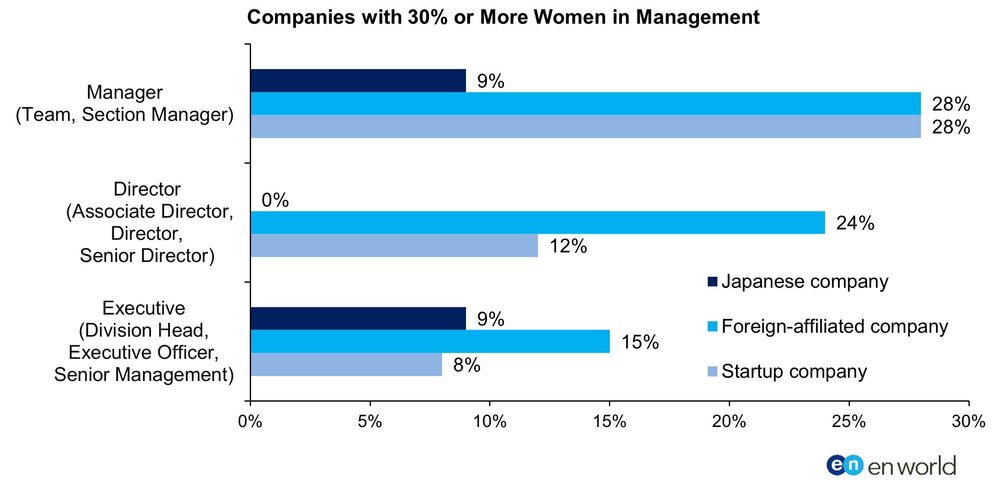
We asked hiring companies (hereafter, “companies”) about the proportion of women in management positions at each organizational level. Our survey revealed a significant difference between the percentage of Japanese and foreign-affiliated companies that reported women occupying 30% or more of management positions in their organization. Japanese companies reported low numbers of women in management positions: women hold only 9% of positions at the manager and executive levels, and none of the director-level positions.*
In contrast, foreign-affiliated firms significantly exceed Japanese companies across all levels, with women holding 28% of positions at the manager level—a 19-point gap compared to Japanese companies—24% at the director level, and 15% at the executive level.
Startups also exceeded the percentage of women in management positions compared to established Japanese companies, with women occupying 28% of manager-level roles, 12% of director-level roles, and 8% of executive-level roles. However, the proportional decline at higher management levels suggests that women's promotion into senior executive positions is limited. In summary, Japanese companies show consistently low ratios of women in management positions, foreign-affiliated firms maintain relatively high levels across all tiers, and startups perform well up to mid-level positions but lag behind established foreign-affiliated companies in advancing women into leadership roles. (Figure 1)
*These results may have been influenced by differences in sample size, as well as variations in organizational structures and workforce composition across companies.
[Figure 1] Please indicate the managerial levels at which the proportion of female managers (manager/section chief level and above) is 30% or higher. (Companies)
2. Over 60% of women at Japanese and foreign-affiliated companies and 75% at startups expressed a desire for promotion. Higher income and better benefits were the top motivators, followed by greater challenges and authority, and career and skill development. Responses were similar across company types.
Female employees at Japanese, foreign-affiliated, and startup companies indicated a strong interest in promotion to higher positions than their current roles. The proportion who responded “interested” exceeded 60% at both Japanese and foreign-affiliated firms and reached 75% in startups, indicating that a majority across all company types are motivated to pursue promotion. [Figure 2]
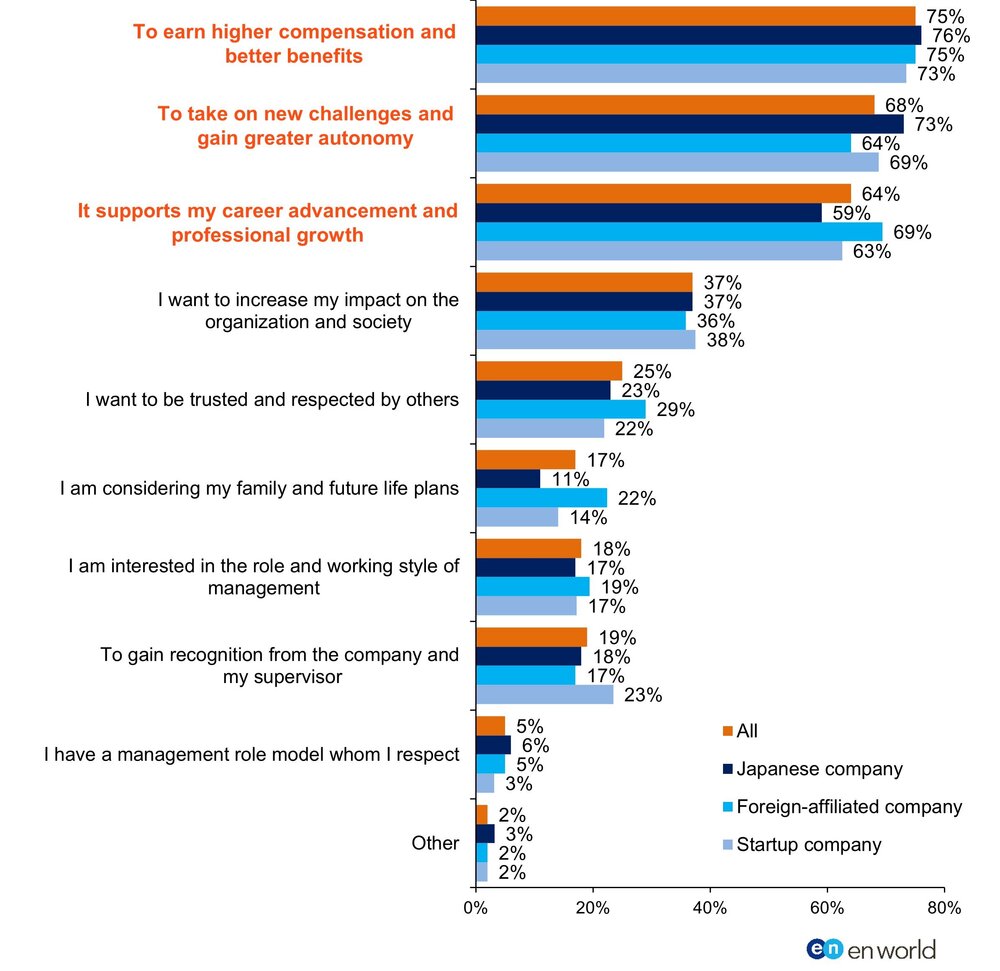
[Figure 2] How interested are you in being promoted to a higher position (e.g., management/senior management) than your current role? (Female employees)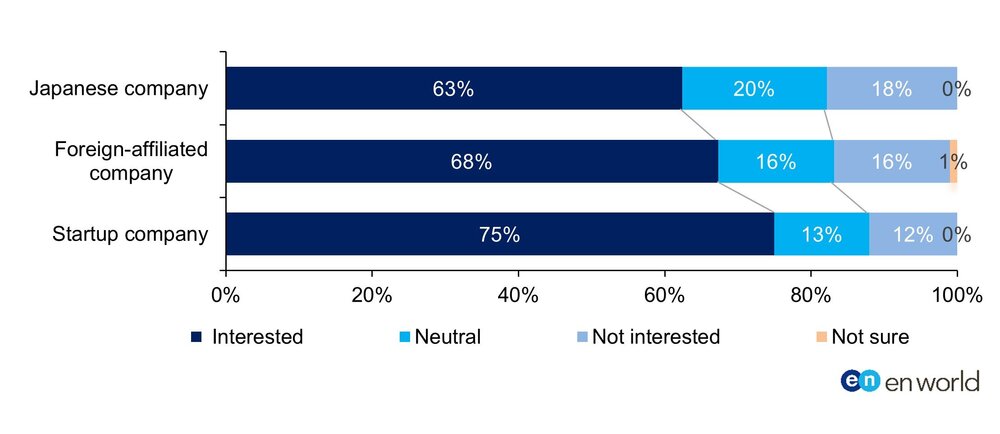 There was also consistency across company types in the reason women were interested in promotion, with more than 70% of respondents citing “improved income and compensation/benefits.” The next most commonly cited answers were “being attracted to new challenges and expanded authority,” and “opportunities for career advancement and enhanced expertise.”
The survey results show that women tend to place importance on opportunities for growth and involvement in decision-making, in addition to improved financial benefits. [Figure 3]
[Figure 3] To those who answered that they are interested in promotion to higher positions (management/senior management): please select the reasons for your interest in promotion. (Female employees / multiple answers allowed)
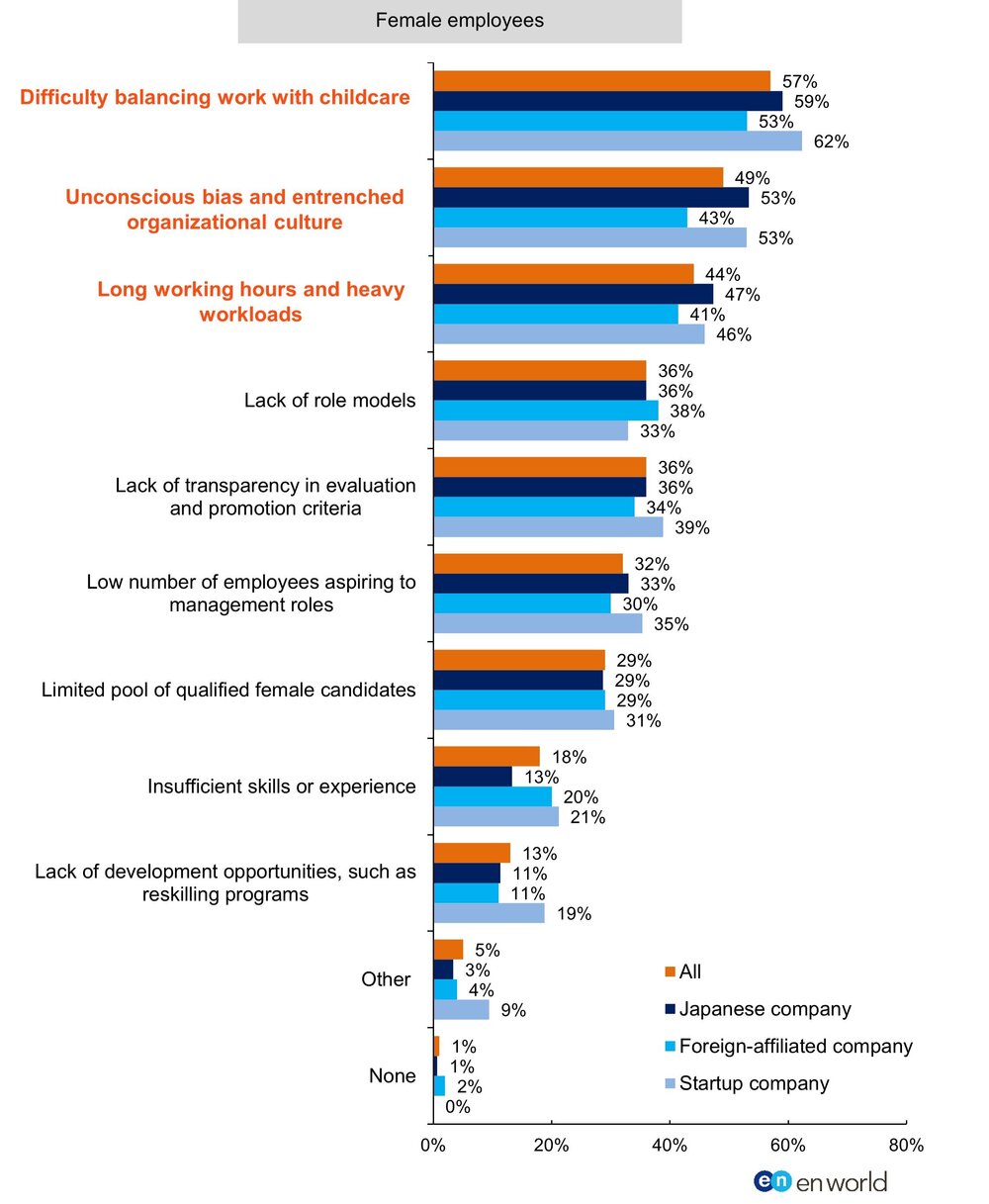
3. The survey revealed a misalignment in understanding why women do not occupy a greater share of management positions. While 62% of companies cited a shortage of qualified candidates, 57% of female employees reported difficulties balancing work with childcare and caregiving.
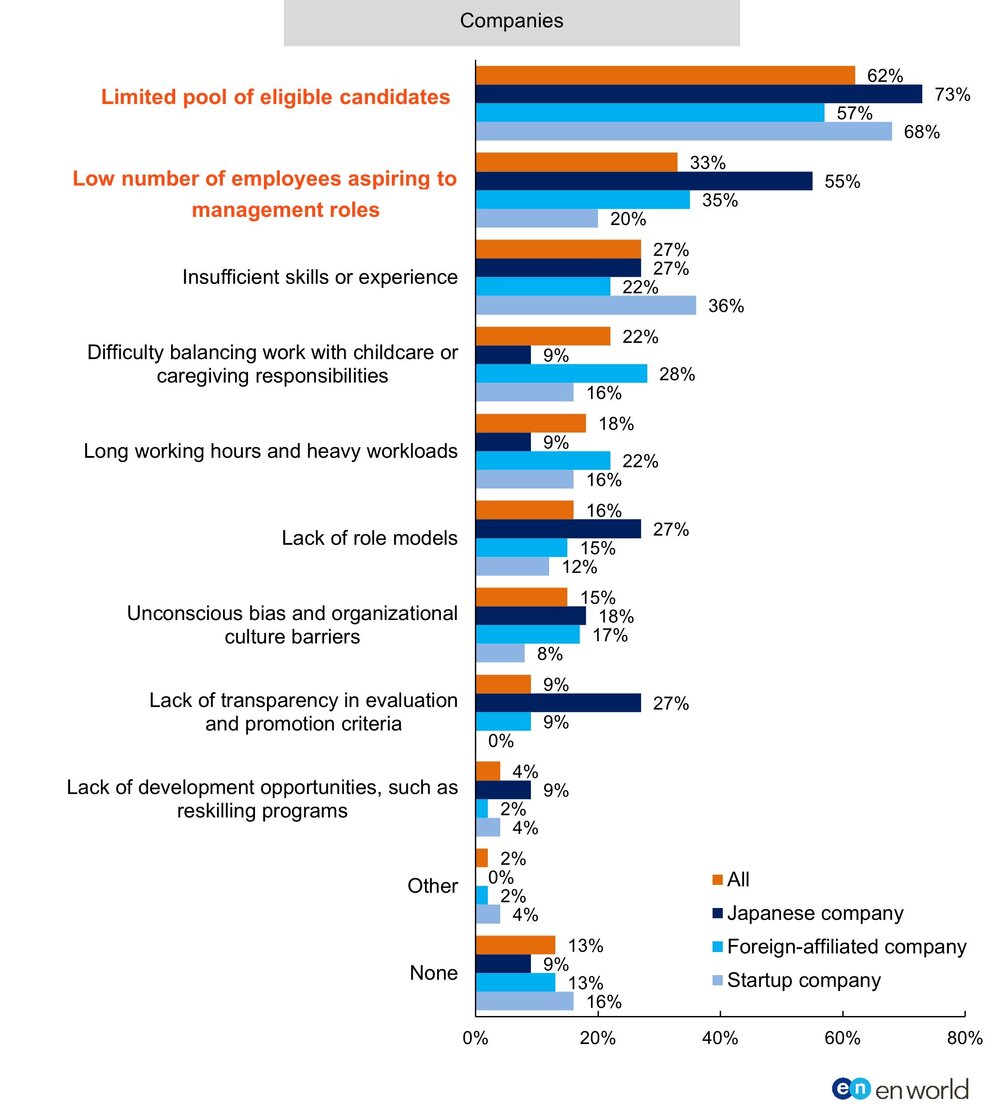
There was a significant difference in the responses between companies and female employees regarding the main challenges in promoting women to management positions. Companies tended to view talent shortages as the primary obstacle to promoting women to management positions: the most commonly cited answer by 73% of Japanese companies, 57% of foreign-affiliated firms, and 68% of startups was a “limited pool of candidates.” Furthermore, 55% of Japanese companies reported a “lack of female employees willing to become managers.” [Figure 4]
[Figure 4] What do you think are the main challenges in promoting women to management positions? (Companies / multiple answers allowed)
In contrast, 59% of women in Japanese companies, 53% in foreign-affiliated firms, and 62% in startups cited “difficulty balancing work with childcare and caregiving” as the primary challenge in promoting women to management positions. This was followed by “unconscious bias and organizational culture” and “long working hours and heavy workloads.” [Figure 5]
These results suggest a clear gap in perception: while companies tend to view talent shortages as the main issue, female employees across all company types feel that workplace conditions make it difficult to pursue promotion.
[Figure 5] What do you think are the main challenges in promoting women to management positions? (Female employees / multiple answers allowed)
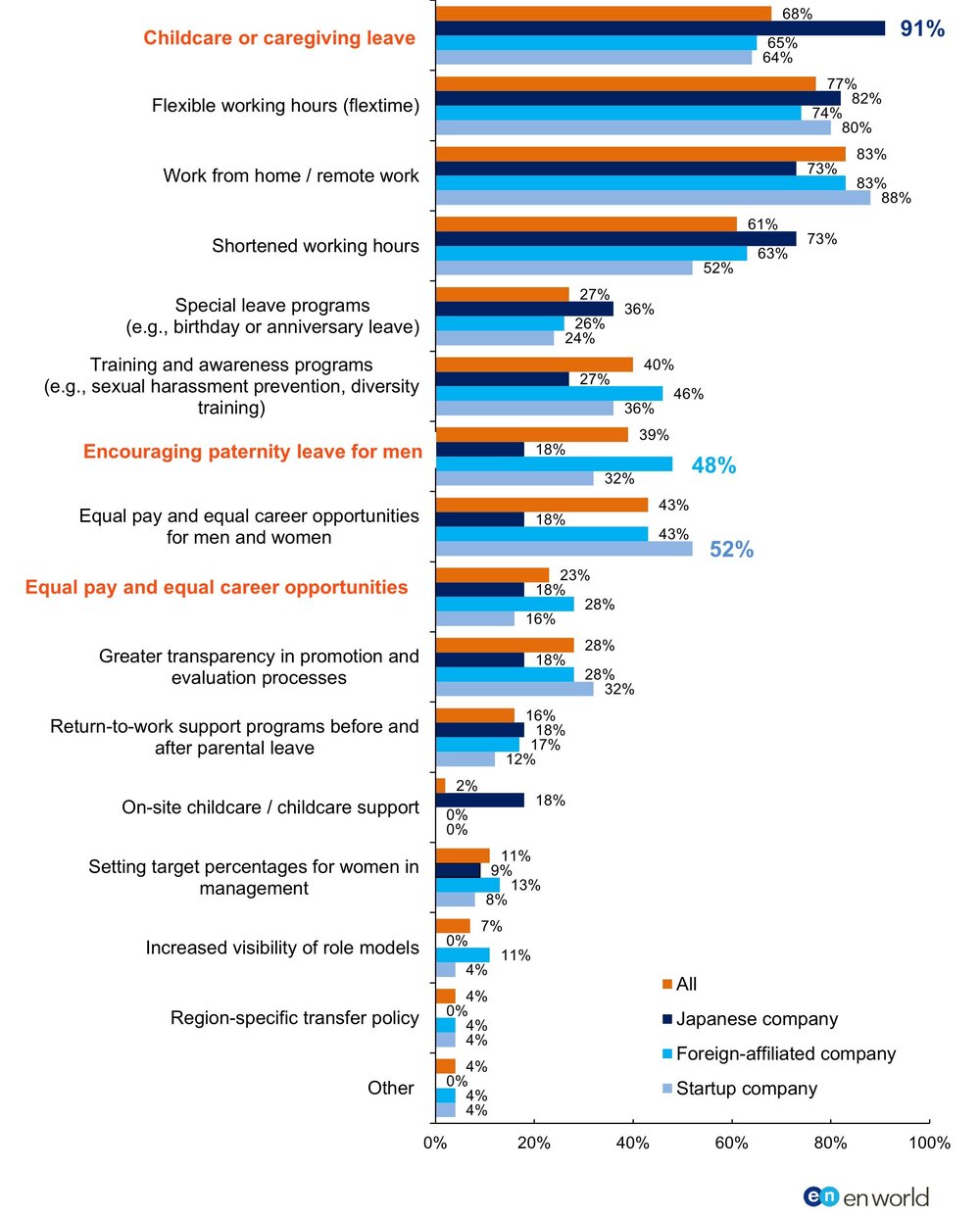
4. HR policies vary by company types. Childcare and caregiving leave was offered by 91% of Japanese companies, compared to 65% of foreign-affiliated firms and 64% of startups. At 52%, startups that reported implementing equal pay and equal career opportunity policies for men and women exceeded both Japanese and foreign-affiliated companies.
The survey revealed differences in how Japanese companies, foreign-affiliated companies, and startups approach the development of frameworks and policies thought to support the promotion of women into management positions. Regarding systems and initiatives already implemented by companies, the most common overall were those supporting work–life balance, such as childcare and caregiving leave, flex-time systems, and remote work/telecommuting. Japanese companies most commonly cited offering childcare and caregiving leave (91%), representing a 26 to 27-point increase compared to 65% among foreign-affiliated firms and 64% among startups.
Foreign-affiliated firms stood out for initiatives targeting organizational culture and awareness, such as encouraging men to take parental leave (48%) and “training and mindset reform” (46%).
In startups, the implementation rate of policies on equal pay and equal career opportunities for men and women reached 52%, exceeding that of both Japanese and foreign-affiliated companies. Additionally, transparency in promotion and evaluation processes (32%) was relatively high, highlighting a focus on fairness and transparency. [Figure 6]
[Figure 6] Please tell us about the systems and initiatives your company has implemented. (Companies / multiple answers allowed)
Key Survey Findings
While women show a high willingness to pursue promotion regardless of company type, there are differences in the actual proportion of women in management positions, with higher ratios observed in foreign-affiliated firms and startups compared to Japanese companies. As for the main challenges in promoting women to management roles, companies most frequently cited a limited pool of candidates (62%). In contrast, female employees identified difficulty balancing work with childcare and caregiving (57%) as the key challenge, revealing a gap in perception between the two groups. These trends suggest that while companies tend to view the issue as a talent shortage, female employees place greater importance on the work environment, particularly the ease of balancing professional and personal responsibilities, when considering promotion.
Furthermore, differences were observed in the systems and initiatives implemented across company types. In Japanese companies, the adoption rate of childcare and caregiving leave is very high at 91%. However, given the low numbers of women in management positions at Japanese companies, the results of this survey do not clearly indicate whether this policy has a positive impact on lowering the challenges women face in getting promoted into managerial positions.
In contrast, startups show a relatively high implementation rate of policies on equal pay and equal career opportunities for men and women (52%). This suggests that such fairness-oriented initiatives may be associated with higher ratios of women in management. These initiatives could serve as one potential solution to promoting women into management roles going forward.
[Survey Overview]
Methodology: Online survey
Coverage: Nationwide (Japan)
Survey period: February 21–25, 2026
Sample size of employees: 418
-Respondent breakdown: 144 from Japanese companies, 189 from foreign-affiliated companies, and 85 from startups
-Response format: Single-choice and multiple-choice questions
Sample size of companies: 82
-Respondent breakdown: 11 Japanese companies, 46 foreign-affiliated companies, and 25 startups
-Response format: Single-choice and multiple-choice questions
About en world Japan
en world Japan is a recruiting firm specializing in global talent acquisition, with expertise in recruitment and job placement support for middle- to high-level positions at foreign-affiliated and Japanese global companies.
Through services such as permanent placement, executive search, professional staffing, and recruitment process outsourcing (RPO), the company supports both individuals and organizations as a long-term partner in achieving growth and navigating change.
Press Contacts
en world Japan K.K.
12F Tokyo Square Garden 3-1-1 Kyobashi, Chuo-ku Tokyo 104-0031
Email: enworld-pr@enworld.com